
⚡ Quick Answer
At an MIAM (Mediation Information and Assessment Meeting) in Wokingham, UK, you meet a family mediator, usually on your own, for about an hour. You explain your situation, the mediator explains how mediation works and your options, and they screen for any safety concerns. It isn’t a mediation session, and you can’t “fail” it. At the end, you decide whether to mediate, and the mediator can sign a certificate if you need to go to court.
Key takeaways
- A MIAM is the first meeting, held individually. Your ex isn’t in the room with you.
- It’s an information-and-assessment chat, not a negotiation and not a mediation session.
- The mediator screens for domestic abuse or risk to check that mediation is safe and suitable.
- Under the Children and Families Act 2014, you usually need one before applying to the family court, unless an exemption applies.
- It ends in one of three ways: mediation proceeds, you get a court certificate, or you choose another route.
You’ve booked a MIAM, or you’re about to. And now you want to know what you’re walking into. Fair enough. The good news: it’s a conversation, not a courtroom, and nobody’s testing you. Below is exactly what happens, in the order it happens.
So, What Actually Happens at a MIAM in Wokingham, UK?
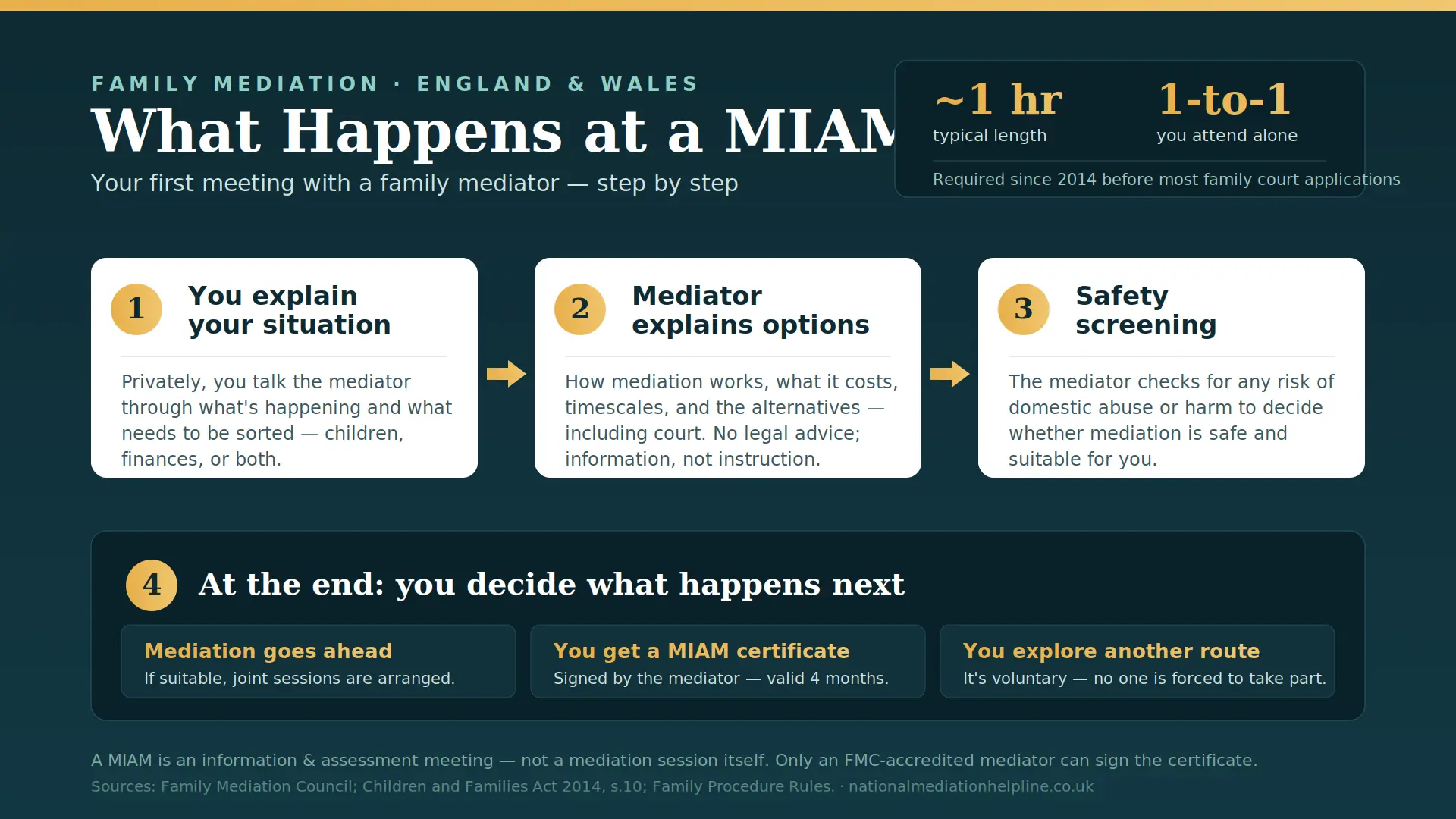
An MIAM is a one-to-one meeting with a trained family mediator that runs for roughly an hour. You talk through what’s going on, separation, child arrangements, money, or all three. The mediator explains how mediation works, checks whether it’s safe and suitable for you, and answers your questions. You leave knowing your options. That’s the whole job of the meeting.
Think of it in four beats. To begin with, you state your case, what the matter is on your end, what things require fixing, and what you are anxious about. The mediator then describes what it will be like, the approximate costs, how long it will take and your options (including court). The next quiet but significant step is to check whether it is safe. And finally comes a decision, yours, about what to do next.
The Family Mediation Council says the meeting lasts about an hour and gives you the chance to tell the mediator about your situation and the issues that need deciding, after which the mediator tells you whether your case is suitable for mediation. No surprises, no ambush. You’ll mostly be doing the talking early on.
Who’s in the Room, and Do You Go on Your Own?

You attend your MIAM on your own. Just you and the mediator. Your former partner is invited too, but they go to a separate meeting, you don’t sit together, and you’re not negotiating with them at this stage. That’s deliberate: it lets you speak openly without managing the other person’s reaction.
Each of you has your own meeting matters for a reason most people miss. You attend the meeting with your mediator on your own, without your e, so you can speak freely about your perspective, what you wish to achieve, and any hopes or concerns you have. If you’d feel steadier with support, many mediators will let you bring someone along, ask when you book.
One thing to be clear about: the mediator is neutral. They’re not your advocate and not your ex’s. They won’t tell you who’s “right” or give you legal advice. Their role is to run the process fairly and help you decide whether mediation is a good fit.
How the National Mediation Helpline Wokingham, UK Can Help You ?

You don’t have to work out the next step on your own. The National Mediation Helpline connects families across England and Wales with qualified, accredited mediators — so instead of guessing where to turn, you get clear, practical guidance and a route forward without the stress and cost of court. One free, confidential call is enough to start.
Here’s what that looks like in practice.
You talk to someone who gets it.
The first call is confidential and free. You explain what’s going on — separation, child arrangements, finances, or all three — and you get straight answers about your options. No jargon. No pressure to commit to anything.
You’re matched with the right mediator.
Our mediators are accredited and registered with the Family Mediation Council, which means they’re qualified to run your MIAM and sign the certificate if you ever need to go to court. We point you to the right person for your situation, not a random name off a list.
You find out what help you’re entitled to.
Worried about cost? The team can check whether you might qualify for legal aid, or for the government’s Family Mediation Voucher Scheme — up to £500 toward the cost of mediation if you’re eligible. Better to know early than assume you can’t afford it.
You fit it around your life.
Lines are open from 8am to 8pm, evening and weekend appointments are available, and you can request a callback at a time that suits you. Mediation can be in person or online, whatever works for your circumstances.
Conflict has a way of dragging on the longer it sits. The sooner you talk it through, the sooner things start to settle.
What Does the Mediator Actually Do During a MIAM?
The mediator does three jobs in your MIAM: they gather your story, inform you, and assess. They’ll ask what’s happening and what needs to be resolved. They’ll explain how mediation works, what it typically costs, how long it can take, and what other options exist. And they’ll quietly assess whether mediation is safe and appropriate for your circumstances.
That third job, the assessment, is the part the name hides. Behind the friendly chat, the mediator is running a screening check. Mediators are required to see you individually so they can check whether you have any concerns about any abuse, harm, or anything else that might make mediation unsuitable. If there’s a history of domestic abuse or a safety risk, mediation may not be the right path, and the mediator will say so.
They’ll also point you toward practical help — separated-parenting information, financial guidance, and legal advice from a solicitor if you need it. On the money side, the mediator will explain whether you might qualify for legal aid (which can cover the MIAM itself if you’re eligible) or the government voucher scheme that can contribute toward later sessions.
More on the cost side here: How much does mediation cost in Wokingham, UK?
What Most Articles Won’t Tell You?
A MIAM is an assessment, not an audition. There’s no way to “fail” it, and no decision is being made about your case. And it’s confidential in a specific way: what you say in your individual MIAM isn’t shared with your ex, and generally can’t be used against you in court later. That privacy is the whole point of the separate meetings, so you can be honest.
MIAM Vs an Actual Mediation Session in Wokingham, UK | What’s the Difference?
People mix these up constantly, and it causes real anxiety. A MIAM is the information and assessment meeting at the start. According to the Family Mediation Council, mediation involves working together with a mediator to address issues and explore possible solutions, and the process is different from other ways of resolving disputes. Here’s the side-by-side:
| Who attends | You alone (ex attends separately) | Usually both of you, together or by shuttle |
| Purpose | Information + safety/suitability assessment | Working out actual arrangements |
| Is it required? | Usually yes, before court (unless exempt) | No — entirely voluntary |
| Decisions made? | None about your case | Yes — the agreements you both reach |
| Typical length | About an hour | A series of meetings, often 3–5 |
| Who can run it | An FMC-accredited mediator | An FMC-accredited mediator |
The headline: you can attend a MIAM and decide mediation isn’t for you, and that’s a completely normal outcome. A MIAM is not a mediation session. It’s the gateway, not the journey.
If mediation does go ahead and you’d rather not be in the same room, sessions can be run by “shuttle” or online. Those logistics have their own page:
Read More on : How online mediation works in Wokingham, UK
What Happens at the End of a MIAM?

At the end of your MIAM, you decide what happens next. There are three normal outcomes. One: mediation looks suitable, and you both want to proceed, so joint sessions get arranged. Two: you need to go to court, so the mediator signs a MIAM certificate confirming you attended. Three: you decide mediation isn’t right for you and explore another route. All three are valid.
That certificate is the bit people fixate on, so here’s the plain version. A MIAM certificate is a form which is signed by the mediator confirming whether mediation is suitable at that point. Only accredited mediators by the Family Mediation Council can sign one. It’s valid for 4 months and allows you to issue proceedings within that period. You attach it to your court application. The C100 for child arrangements or Form A for finances.
There’s no pressure to choose the mediation route on the spot. Take the information away, think it over, and talk to a solicitor if you want. The decision is yours.
Be Prepared More | MIAMs explained: exemptions, certificates and next steps
Is a MIAM the Same Across England and Wales?
Yes. The MIAM requirement applies across England and Wales, and it’s set in law rather than left to individual mediators. Section 10 of the Children and Families Act 2014 provides that any person who wants to make a relevant family application must first attend a MIAM to find out about and also consider mediation or other forms of out-of-court dispute resolution. So whether you’re in Manchester, Cardiff, or a village in Devon, the meeting covers the same ground.
What can vary is the practical stuff: a mediator’s hourly rate, whether they offer in-person or video appointments, and how soon they can see you. The substance of the meeting, information, assessment, safety screening, certificate, is consistent because it’s tied to the Family Procedure Rules, not to a postcode.
One genuinely useful nuance: the requirement bites at the point you want to apply to court. If you want to apply to the family court for a child arrangements order on a C100 form or a financial remedy order on a Form A, the default position under section 10 and subsection 1, means 10(1), of the Children and Families Act 2014 is that you must attend a MIAM first. Certain exemptions exist, domestic abuse and genuine urgency among them. But those are a topic in their own right, and you should check whether one applies to your situation rather than assume.
Complete Guides | Could the family mediation voucher help with costs in Wokingham, UK?
A Few Quick Definitions
- MIAM: Mediation Information and Assessment Meeting. Your first, individual meeting with a family mediator.
- Mediation: A voluntary process. In this, a neutral mediator helps you and your ex reach your own agreements about children or finances.
- MIAM certificate: The signed form confirming you attended a MIAM; needed for most court applications and valid for four months.
- FMC-accredited mediator: A mediator authorised by the Family Mediation Council. Only they can sign a MIAM certificate.
- C100 / Form A: The court forms for child arrangements (C100) and financial remedy (Form A) that the certificate attaches to.
- MIAM exemption: A legally recognised reason you don’t have to attend before applying to court.
Your Obvious Next Steps in Wokingham, UK
If you take one thing into your MIAM, make it this: you’re there to gather information and be heard, not to perform or commit. Turn up, be honest about your situation and any worries, and ask every question you’ve got. Whatever you decide afterwards, mediate, go to court, or pause, the meeting has done its job the moment you walk out knowing your options.
FAQs : What More Happens at a MIAM in Wokingham, UK?

Q: Is a MIAM the same as mediation in Wokingham, UK?
No. A MIAM is the first, individual information-and-assessment meeting. Mediation is the joint process that may follow it. You can attend a MIAM and still decide not to mediate.
Q: Do I have to attend with my ex?
No. You each attend your own MIAM separately, so you can speak freely. Your former partner is invited to their own meeting, but they can’t be forced to come.
Q: Can I fail a MIAM meeting in Wokingham, UK?
There’s nothing to fail. It isn’t a test or an assessment of your case. It’s there to inform you and to check whether mediation is safe and suitable. The mediator isn’t judging you.
Q: What if I don’t want to do mediation after the MIAM?
That’s fine. Mediation is voluntary in Wokingham, UK. If you’ve attended a MIAM and choose not to proceed, the mediator can sign the certificate you’ll need to apply to court.
Q: How long does a MIAM last in Wokingham, UK?
Usually about an hour, though it can vary with the complexity of your situation. The Family Mediation Council describes it as lasting roughly an hour.
Q: Will the mediator give me legal advice?
No. Mediators are impartial and don’t act as anyone’s solicitor. They’ll explain the process and your options, and they’ll often suggest you get independent legal advice alongside mediation which is applicable to the Wokingham, UK citizens.
Q: Is what I say in the MIAM confidential?
Yes, with limited safety-related exceptions. What you say in your individual meeting generally isn’t shared with your ex or disclosed to the court. Which is precisely why the meetings are held separately in Wokingham, UK.
Q: Does my ex find out what I said?
Not unless you agree to share it. The MIAM is your private conversation with the mediator. Only the information you’ve agreed to can be passed on.
Q: What happens if there’s been domestic abuse?
Tell the mediator. That’s part of what the safety screening is for. If there’s abuse or a risk of harm, mediation may not be suitable, and you may not need to attend a MIAM at all under the exemptions. Speak to a qualified adviser about your specific situation.
Q: Do both of us have to attend MIAM in Wokingham, UK before mediation can start?
Generally, yes. Joint mediation can’t begin until both of you have attended an MIAM and both have agreed it’s the right route. If your ex won’t engage, you can still get a certificate to go to court.
Q: When can I obtain my certificate following a MIAM?
This is usually issued soon after the meeting (and confirmation by the mediator that they will attend), but varies between service providers. The certificate shall be valid for 4 months from the date of issuance in Wokingham, UK.
Q: Is the MIAM free in Wokingham, UK?
It depends. If you qualify for legal aid (which is means-tested), the MIAM can be free. Otherwise, mediators charge a fee for it. Ask the service for their rate when you book, as it varies.